Thursday, January 3, 2013

Temples and Shrines

Since we were up at 3 this morning we had what felt like a long day.  We started by writing yesterday’s blog then when the hotel’s restaurant opened up we headed downstairs for breakfast.  Breakfast was interesting.  They did have traditional western breakfast (eggs, sausage, cereal, etc) but they also had Japanese breakfast which we mostly ate.  We each had a couple of bowls of rice, sometimes with curry sauce sometimes without, but we also had miso soup, salad (this was strange for breakfast as it was like a regular dinner salad), and Chris opted for the salmon and mackerel.  There were also pickled vegetables to go with all of this, which made for an interesting, but good, meal.  Despite it being called breakfast we thought this was all more like a lunch.


When we got back to our hotel room we noticed a pants press in the closet that we had not noticed the night before.  We had one of these the last time we were in Japan and it seemed very useful.  It is a little bit wider than an ironing board but much shorter.  We didn’t use it this time but we liked it because you put your pants in there, hit the button and they are pressed.  You don’t have to bother with an iron, this press does it much quicker.  We think our Uncle Timmy would like this press.  There was also an interesting water boiler for tea in the room, which seem pretty standard in hotels in Japan.  You tend to find these in Japan rather than coffee makers in the hotel rooms.


We left the hotel just before 8 this morning.  The plan for the day was to drop our luggage off in a locker near where we would be staying for the night then head out with just our backpack.  We took the train to Yokohama, a city a little south of Tokyo.  The most unusual thing about our trip to Yokohama was that the train was practically empty.  That is unheard of in Japan and later in the day they more than made up for it with large crowds on the other trains we took. 

When we got to Yokohama we immediately found lockers but unfortunately they did not take coins (even though they are called coin lockers).  They only took something called a Suica card.  We did not have a Suica card nor could we find a place to get one (we later found out you can get them in the vending machine…they are basically pre-paid debit cards you can use on subways, on trains and in convenience stores) but we thankfully found some real coin lockers nearby to store our stuff.  We inserted our 400 yen into the machine, stuffed our small carry-on/suitcase plus our duffle bag in, and we headed back toward the train to go towards a town southwest of Tokyo called Kamakura.  Again, our train was fairly empty, at least by Japanese standards. 


Kamakura was once the seat of a feudal government set up in 1192.  It is now known for its historical sites, its beaches, and its easy commuting distance to Tokyo.  The city has many popular temples and shrines, only a few of which we went to, as well as well-preserved historic treasures in a hilly, rustic setting.  The area was pretty crowded throughout the day as the New Years’ holiday is one of the most important holidays in Japan.  Most people are off for the first few days of the year (and most major attractions are closed) so that people can travel, visit family, and celebrate.  Many people do Hatsumode, which is their first visit to a temple or shrine in the new year.  Hatsumode festivities are held at practically every shrine and temple across Japan. At popular shrines and temples you can experience a festive atmosphere with food stands and many people lining up for a prayer at the main hall, purchasing lucky charms for a fortunate new year and disposing their lucky charms of the past year.  We would experience more of this later in the day.

We arrived at our first stop, Engakuji, while it was still relatively early in the day.  Engakuki Temple is one of the most celebrated ZenBuddhist temples in Japan and the buildings are all built in a grove of Japanese cedars.  The temple was founded in the year 1282 and while there have been fires over the years which required most of the buildings to be rebuilt at one time or another, the oldest thing on the site was the Ohgane, or the temple bell, which was donated in the year 1301.  The main gate, which was just a 2-3 minute walk from the train station, was built in the year 1783.  There were about a dozen or so other buildings and temples on the site but one of the most interesting is a shrine called Shari-den, which is where Budda’s tooth is enshrined.  Besides the age of some of these buildings we were also impressed by the intricate detail that was found carved into some of the buildings.


The stairs to the bell


After leaving Engakuji we walked across the street and up the hill towards another temple called Tokeiji Temple.  This was another Zen temple, this one founded in the year 1285. It was called a “divorce temple” in feudal days, as it was a place of refuge for wives mistreated by their husbands. 

 
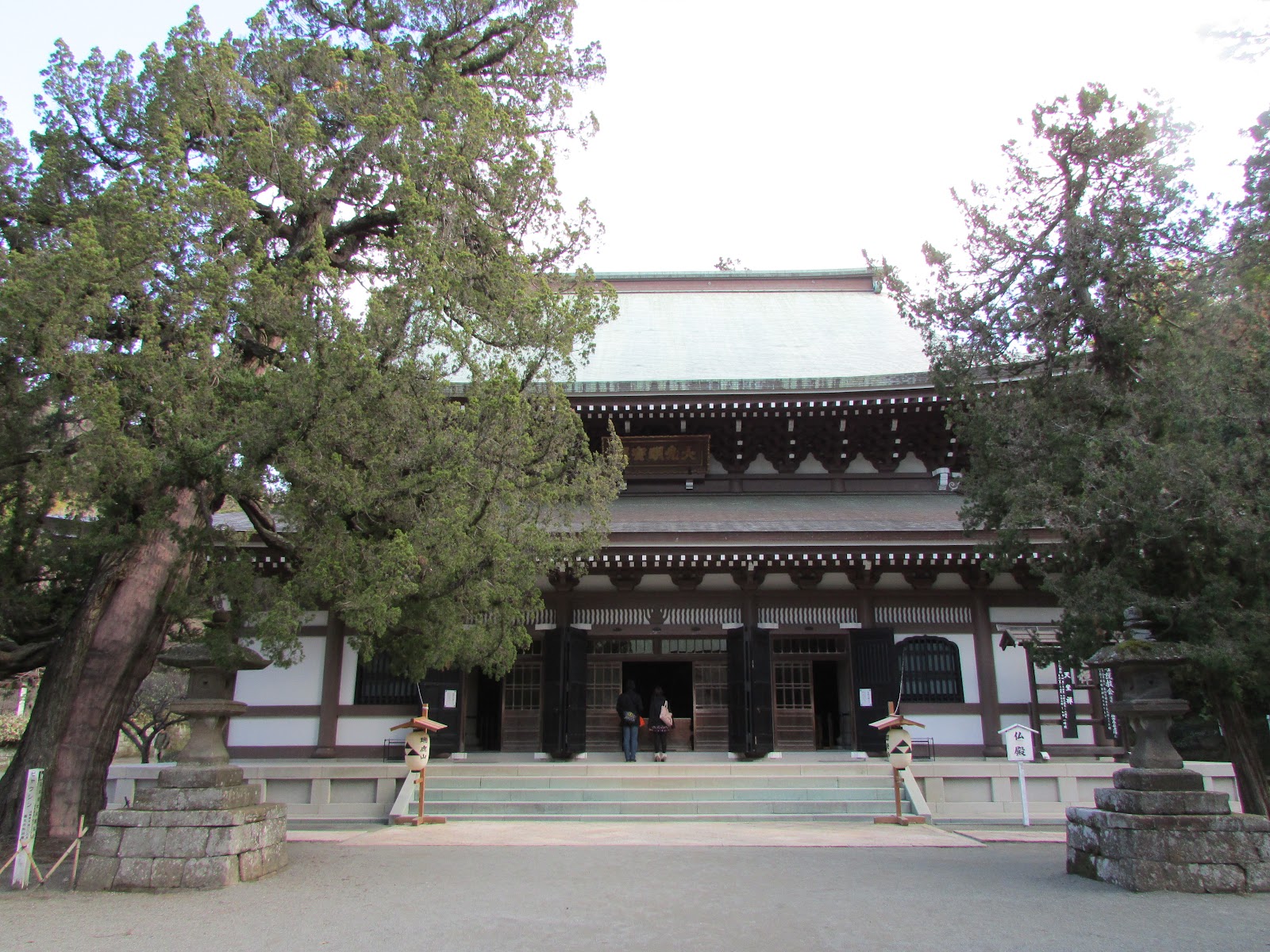
After Tokeiji we headed up the road with the many other people who were out today, towards the next temple, Kenchoji  Temple.  This was about a 15 minute walk up the road from Tokeiji.  It was a little more crowded at this temple but it was also larger and more spread out.  One of the more interesting things here was a grove of juniper trees which were planted over 750 years ago.  The buildings at Kenchoji were built in the 1200’s.  There was also in impressive golden gate (we could not determine from any of the English paperwork we were given if it was made of gold or just looks that way) just outside of the Buddha Hall.  Both the gate and hall were moved here piece by piece in 1647.


At each of these temples there were numerous stone lanterns lining the pathways.  Japanese stone lanterns have been around since the 700’s.  They were originally placed only at Buddhist temples but today they are at most Buddhist and Shinto temples as well as in many gardens.  Each of the five elements in the Buddhist cosmology is represented by the stone lanterns: the piece touching the ground represents the earth; the next section water; the section where the light is held represents fire; and air and spirit are represented by the top two sections.


We then walked towards the main part of Kamakura where the crowds were.  We did not walk all the way up to the Tsurugaoka Hachimangu Shrine, which was next, because there were literally 10’s of thousands of people already there and the line to get in was about a dozen people wide and easily a quarter mile long.  It seemed to be moving fairly quickly but with that many people we figured you would not be able to get a good look at whatever was in there. 

The best part of having all of these people around and the New Years’ celebrations, were the many food vendors that were set up all along the way selling both strange and good stuff.  The food is probably best described as typical fair food, similar to what you would find at a fair back home but with a Japanese twist. 


We did not try everything but some of the more notable foods Takoyaki, which are ball shaped pancakes with a chunk of octopus in the middle(we did not try it),


Okonomiyaki, which are Japanese pancakes made with leftovers from the fridge which usually include pork, seafood and cheese.  The one we ate also had a sunny side up egg cracked right over the top. 

Ikayaki which is grilled squid on a stick, we did not try this. 

Jaga Bata, which was probably our favorite, the most interesting, and tastiest.  It is a deep fried potato with butter, they really put a lot of butter on it and then salted it to death but it tasted great!  We are pretty surprised to not have seen this at fairs back home because they seem to deep fry just about everything. 


Ringo Ame, which is a candy apple.  We ate the candy strawberry which was different but great.   


Dango which we have had before, is a Japanese rice dumpling made from rice flour.  The one they gave us was right out of the steamer and it took us a few minutes before we could bite into it without burning ourselves.


After getting our fill we headed down to the train station where we knew we would encounter a very crowded train.  This was the Japan we know and don’t really love, people invading your personal space, touching you, being pressed up against the glass, etc.  Luckily it was a short ride, only three stops, or just under 5 minutes. 


Chris thinks the guy in the window looks a little like Einstein

We got off at the Hase station and walked about 10 minutes up the hill towards a giant Buddha.  Near Nagoya we had seen another large Buddha the last time we were here but this one was even bigger.  This was built in the year 1252, it weighs 121 tons and is over 37 feet tall.  We spent some time here before heading back to the train, which this time was a little less crowded. 


We grabbed a spot (notice we didn’t say seat) at the back of the train where we could look out the back as we travelled down the tracks.  This train ran through narrow residential areas, at one point a woman was walking her scooter behind the slow moving train because it seemed that her sidewalk spilled right out onto the tracks and she had to walk a short distance down the tracks to get to the street.  The train also ran right along the beach area.  Despite it being winter there were quite a few people out surfing in the ocean.


We eventually made our way back to Yokohama, where we picked up our luggage from the locker and got on a subway for the short ride to our hotel for the night, the Intercontinental Yokohama Grand, which is a great place overlooking Yokohama Bay. When we were buying our subway tickets we took an interesting picture that most people reading this will think is just craziness.  When you buy your subway and train tickets you don’t pay a flat rate like you may in some cities but instead you pay by the distance you are going.  You pay in advance which means you have to look at a map and see what it costs to where you are travelling to.  If you don’t know you could always pay a minimum amount and on the way out you’d visit a fare adjustment machine where it would tell you what you owe.  Anyway, we took a picture of the subway map to give you an idea of how confusing it can be. Even when the signs are in English as many of the maps are it is still quite confusing trying to figure out how much you would pay, or even trying to figure out where you are going.

 
By the time we got there we were exhausted.  We were disappointed to have to wait in line for over a half hour to check in, the person at the desk told us that because of the New Year holiday it was much busier than normal.  After waiting for 30+ minutes Chris saw a sign for special check in for priority club members (members of the Holiday Inn chain’s frequent guest club).  The sign had been turned around when we first got there but once he saw the sign he jumped off of the line and was able to only wait 10 more minutes to check in.  We would have easily waited another half hour or more had we not gotten off of the line.  Finally after what seemed like a really long day we made it to our room with a view.
 

Wednesday, January 2, 2013

Happy New Year!

We never really went to sleep on New Years’ Eve or early on New Years’ Day.  Our taxi was scheduled to pick us up from Stony Point at 3 AM on New Years’ Day for the ride to LaGuardia Airport and our 6 AM flight.  We had been on the fence about getting a cab because we thought that the early hours of New Years’ Day would be more lucrative for cab drivers to stick around and drive impaired people short distances than it would be to take a couple of hours and drive someone to the airport.  We had thought about renting a car and driving ourselves to the airport but we were given the cab ride as a gift so we gladly accepted it.  This was good as we were able to party with everyone else on New Years’ Eve without worrying about driving later on. At 3:00 sharp the cab pulled up in front of the house.  The driver obviously did not expect two people with 8 pieces of luggage (4 checked and 4 smaller carry ons).  We tried valiantly to fit all of the luggage into the car but it just was not going to happen.  We could not get more than two suitcases into the trunk which meant two suitcases plus 4 smaller bags into the back seat with a person, which as you may imagine, did not work.  The cab driver called the cab company and told us that a bigger car was being sent, and he then left.  So we waited.  Finally at about 3:30 AM a mini-van showed up which had plenty of room for all of our stuff.  The van had a driver and let’s call him the driver’s friend.  They were both nice guys but it seemed that the friend had had a rough night so far.  He was wearing slippers and he immediately asked us if he could have a bottle of water.  He also mentioned to the driver that he had to pee very badly.  The driver told him to go in the bushes across the street from the house.  He never got a chance to because Jackie’s mom came outside just before he was about to go.  We got him his water as the two of them cleaned the previous party out of the van and we settled in.  They failed to clean out the tray of food that was sitting on the floor between them probably because they were hungry.  They ended up eating from this tray of food the whole trip. The ride down was certainly adventurous.  The driver had inconsistent driving habits.  He was consistent in that he drove with his high beams on the whole way.  He was especially skilled at speeding and tailgating, but only when were were on one lane local roads.  Once we got on the Thruway he drove 10-15 MPH under the speed limit in the left lane of course.  On the side roads where the speed limit was between 30 and 45 he drove 55-65 when there was no one in front of us and rode everyone’s bumper when there was an unfortunate soul in front of us. We are also pretty sure the driver did not know that you could jump on the parkway and quickly make your way to the Tappan Zee Bridge from our location in Stony Point.  Instead he took the scenic way to the bridge, stopping at every single red light, even at 3:30 in the morning. We also had the pleasure of listening to La Mega (salsa & merengue) and Hip Hop the whole way to the airport.  We crossed over the TZ Bridge and the driver got off the exit for the Saw Mill Parkway.  We were surprised by this because not only is it longer, but there are traffic lights.  We could only guess that he did this to avoid the toll in Yonkers on the Thruway.  While we were driving Chris noticed on his phone that his upgrade had been processed for the flight, so we could now legitimately check in at the first class counter when we got to the airport.  More on this later.  Our driver also did not have an EZ Pass in his car.  Normally at 4 in the morning this is not a problem as there is no traffic on the road. However when we got to the Triboro bridge at about 4:20 only two cash only lanes were open and the line of traffic for those two lanes stretched all the way across the bridge to the Bronx.  If you have ever been to the Triboro Bridge you know this is not good.  We managed to get to the front of the line about 15 minutes after we got onto the bridge, right as they opened a third cash only lane.  We arrived at the airport about 10 minutes later, paid our friends, gathered our stuff and made our way inside to a mad house. We never did stop to let the driver’s friend pee. While our description of the drive down may have a negative tone, it certainly added to the fun of our trip and we greatly appreciated having the ride instead of having to deal with the rental car and all of that hassle.  We never felt unsafe with those guys driving, it just made for a good story.  Thank you Jose, Mami and Papi for the cab!

We were flying through Dallas before continuing onto Tokyo.  We bought this longer route because it was several hundred dollars cheaper than the direct NYC-Tokyo routing.  Chris’s ticket did not matter as work was paying but we had to go for the cheaper option for Jackie’s ticket, which we were paying for.  Chris also had a business class seat on the Dallas to Tokyo flight while we had to pay for Jackie’s coach ticket then use miles to upgrade her to business class.  For those of you who have never flown outside of coach (this would include us if it were not for Chris’s job), a business class seat is a step up from a coach seat on a flight that has three classes of service (coach, business and first).  Three class service flights are typically your longer haul routes such as transcontinental or international.  Everything else is two class, coach and first.  A business class seat is exactly the same as a first class seat on most planes.  The first class seats on three class flights are even better.  We only sat in a first class seat on a 3 class flight once and it was even nicer that what you normally pass through before you duck behind the curtain when we all fly. 

We were stressing the week before because Jackie’s upgrade request had not yet cleared.  Just because you request an upgrade it does not mean you get one.  The airlines set aside a certain number of seats for upgrades, probably no more than two.  If you are the first one to request one of these seats you get it no problem. In fact on our return trip we already are confirmed for the business class seats.  However on our trip out we were put on a request list for the upgrade.  They limit the number of upgrades available because the airline would obviously like to sell those tickets rather than give them away for miles.  Your status with the airline (ours is the dirt level, which is the same as 90% of the other fliers) determines how long before your flight your request goes through.  The most elite fliers, people who probably fly something crazy like 100 days or more a year get their requests approved 100 hours before the flight.  Platinum status people (people who typically fly more than 50K miles per year), 72 hours before the flight; gold status (25K miles per year), 48 hours in advance.  For everyone else, if there are still seats available, it gets approved at the 24 hour mark.  And even then they get processed depending on other factors, such as ticket price paid, when you bought your ticket, and when you requested the upgrade.  We paid a deep discount price for Jackie’s ticket but the good news was that we requested the upgrade back in early November so at least we had that going for us.  On New Years’ Eve we noticed that Jackie’s upgrade had gone through.  She was confirmed in business on the Dallas to Tokyo flight which meant we would be not only both comfortable for the 13 ½ hour flight but we would also be sitting next to each other.  Since the NY to Dallas flight was a two class flight Jackie was immediately bumped to first class.  Now were a little more stressed once again despite the upgrade going through.  We were now stressed (only a little stressed) because Chris’s NY-Dallas flight was a coach seat.  It seems that it is hit or miss when booking through the travel agent at work.  When you have a multi leg international flight they always put you in business.  But on the domestic legs you either get first class or coach, with no rhyme or reason as to which you might get picked for.  (this is only on tickets with an international leg…on domestic trips Chris is always in coach).  Chris picked the short straw and had a coach ticket for the 4 hour flight to Dallas.  We could have requested an upgrade much sooner on this and it would not have cost miles due to another quirk with the airline industry.  You see, Chris’s ticket on the NY-Dallas flight was what they call a Y-Class ticket, or the most expensive coach ticket you can buy.  This is what you would pay if you walked up the counter at the airport and said put me on the next flight.  The Y-class coach seats often cost more money than what most first class passengers pay for their flights. As a result an upgrade is usually granted for free if you simply ask. We didn’t ask sooner because this would have put Chris in line ahead of Jackie for her upgrade.  We feared that if there were no upgrades on the NY-Dallas flight available for Jackie then they would not grant her request on the international leg.  So not until Jackie’s upgrade went through, at 24 hours before the flight, did we request Chris’s upgrade.   At this point all of the dirt status people would have already been granted their upgrades to the chance of there being seats available would be slim to none.  The only good news is that Chris would have been in line ahead of all of the people who request their upgrades when they arrive at the gate.  When we left the house at 3:30 Chris’s upgrade had not yet been granted so we figured he would be sitting with the commoners behind the curtain while Jackie sipped fine wine, ate caviar and had her feet rubbed up in first class.  However while we were sitting in traffic at the Triboro the request went through.  Now, as we said earlier, we could legitimately check in at the first class line.  We would have done so anyway and just said but our second flight is business if asked what we were doing there. 

We were glad to have that option for checking in at the first class line because had we not had that option we probably would have not missed our flight but we definitely would have been rushing.  We made our way through security and went to the Admiral’s club, which having access to is a nice perk of flying a business class or higher international flight. One could buy a one day pass for $50 or an annual pass for $500 but we don’t fly enough to make that worth it.  The good thing about the airport lounge is that you are waiting for your flight in comfort and it is peaceful.  You are not standing around the gate waiting for someone to move their bag off the seat next to them, plus there is free food while you wait.  Since we hadn’t had time for breakfast we had some bagels and cream cheese along with a few glasses of juice.  Since we had first class tickets we were not even worried about boarding immediately when they started the boarding process.  Overhead space is not a problem in first class plus you can walk right to the front of the line while they are boarding.  We walked to our gate after only a 20 minute stay in the lounge and boarded the plane.  Our flight to Dallas was uneventful.   In fact we probably slept for 3 of the 4+ hours.  We even slept right through breakfast!  We arrived in Dallas, bought some aspirin, walked our way to a different terminal where we would be leaving from rather than take the train (we would be sitting too much today) and headed for the lounge once again.  This time we had about an hour in the lounge before we boarded so we just relaxed.
Admiral's Club lounge in NY

The next flight was a big one.  The Dallas-Tokyo scheduled flight is 13 ½ hours.  We are pretty sure it took all of that, maybe even a few minutes more.  The good news about such a long flight is that after 13 ½ hours the plane probably doesn’t have much fuel left so you won’t be circling the airport for too long when you get to your destination.  Other than that there is nothing good about such a long flight.  There are a few noteworthy things though.  As we stated before, we had business class seats. The seats are big enough where if you have the window seat you can walk past (not squeeze past) the person sitting in the aisle seat if you need to get by.  The only time you could not do this would be if the aisle person is sleeping and their seat is set up like a bed (yes, the seats fully recline to just about flat).  They also feed you well.  A menu was waiting for us when we sat down describing your appetizer (bacon wrapped scallops), your salad choice, your main meal choice (a beef entrée, a chicken entrée, a pasta entrée, or a Japanese style entrée), your dessert choice, your mid-flight snack choice (roast beef and provolone sandwich or bento box), your light meal choice (sesame chicken or spinach and garlic Uno pizza), plus a wine and beverage menu.  The wine menu was quite extensive for an airplane (10 choices), and the adult beverage menu included mostly top shelf selections.  They also provided us each with a small personal kit to keep you fresh.  The kit includes several lotions, tissues, earplugs, toothbrush and toothpaste, socks, eye mask, and a pen to fill out the customs form that they never give you.  We were given a choice of champagne or orange juice to sip on while we waited for the rest of people to board; we chose the juice.  Each seat also had a personal entertainment system to help pass the time.  There were about a dozen new release movies available plus numerous tv shows, games to play, a ton of choices for music to listen to, or you could just stare at a map of the planes route and current location, speed, altitude, etc.  We watched a couple of movies, listened to lots of music both on the plane’s system and on our new iPod, Chris played Tetris for about an hour while sipping gin and tonics, and Jackie got sick one time.  Jackie’s stomach does not work well with turbulence and early on we had about 20 minutes straight of turbulence.  Luckily she made it to the bathroom to get sick.  We think it was the smell of Chris’s seafood dish that did it.  While she was gone the flight attendant who seemed to be on top of her job, recognized that there was a problem.  She came by, took Jackie’s food away and asked Chris if everything was ok and if there was anything she could do.  When Jackie returned she got her a can of ginger ale while Chris took advantage of her presence and ordered another gin and tonic.  We slept on and off throughout the flight.  Chris probably slept a total of an hour during the whole flight while Jackie may have slept a few hours in total.  We finally arrived at Tokyo Narita airport at around 5 PM local time, which was exactly 24 hours after that first taxi pulled up to pick us up.  We ended up leaving the house at 3 AM on the 1st and arrived at the airport in Tokyo at 5 PM on the 2nd.  There is a 14 hour time difference involved but it was still a long trip and just because we got to the airport didn’t mean we were done yet.
Ammenity pack


We got off the plane and made our way to immigration.  First we had to ride a tram between terminals and it wouldn’t be Japan if the tram wasn’t crowded.  There were probably 300 people squeezed into a tram that should hold 100. There is no such thing as personal space in Japan.  We made the 3 minute trip to the next terminal (Walking was not an option) and walked towards immigration.  We got on the foreigners line which was much shorter than the Japanese citizen line and were told we needed to fill out a form first.  So we got out of line and did that.  Why they didn’t give us the form on the plane we don’t know.  We got back in line, waited about 10 minutes to get to the front of the line, got fingerprinted(just our index fingers), photo’d and questioned, got our passports stamped, and cleared immigration.  We then headed down to retrieve our luggage before heading to customs.  Our luggage came out quickly (after all we had landed a half hour earlier by now) and there were no lines for customs but once again we were not informed of a second form to fill out.  So we found our forms, filled them out and went back to the customs officer.  He asked the usual questions in broken English, how long are we staying, what is the purpose of our trip, do we have any drugs on us, etc.  After answering correctly to every question thrown at us we were on our way.  We then walked into the main concourse area outside of the secure area at the airport where it was even more crowded than the tram.  We had a free cart to lug our 8 pieces of luggage but making your way through the throngs of people with all that stuff was not easy. Luckily just about every other person also had a cart with luggage so were were not alone.  We went to the currency exchange place where we filled out some more paperwork and got some yen.  We then went to the information booth to inquire about the Black Cat luggage delivery service.  Imagine a place where you do not have to lug your luggage with you up and down stairs, onto trains, through airports, and you could instead let someone else take care of it for you and it will be waiting for you at your hotel. That place already exists, it is called Japan.  We would not have a car in Japan (you do not need one even if you are travelling extensively…public transportation is probably the best in the world)  and the trains do not have space for all of our stuff so just about everyone uses some kind of luggage delivery service.  We chose Black Cat because we had used them before.  Black Cat is not the name of the company but their logo is a black cat and it is easy to remember.  Apparently this company has over 40% of the market share in Japan so their prices are good as well.  If shipping your luggage to your final destination is not awesome enough, the price makes it even better.  We ended up shipping 3 large suitcases (50 pounds each) plus a smaller suitcase, maybe 20 pounds, to our hotel about 200 miles away, for only about $70.  You cannot beat that.  If you live in the country this is how you would likely get your luggage to the airport if you are not driving.  They would pick it up at your house and it would be waiting for you just outside of checkin.  In our case it should be waiting for us in our hotel room when we arrive in Nagoya on Saturday.  We struggled a little bit at the luggage counter mostly because the forms are not in English as they are for customs and currency exchange but one of the people working there was able to help us out.  We said good bye to our larger luggage, keeping only what we would need for the next three days (backpack, duffle bag and small carry on suitcase) along with stuff we didn’t want to get stolen although crime in Japan in any form is rare.  After dropping off our luggage we walked to the train ticket office and bought our ticket on the Narita Express (a train that runs between Tokyo and the airport, about 50 miles away).  The next train was not for about a half hour so we had some time to kill.  We did so by sitting on the train platform because by this point we were too tired to do much else.  We bought a ticket for what they call “green car”, which is essentially just a first class ticket.  Hey, since work is buying one of our tickets, why not?  The green cars are not actually green, this is just what they call them, although there is a green symbol on the outside indicating so.  They are also much less crowded than the other cars on the train. Our car only had about a half dozen people in it while the other cars were likely full. All seats are reserved on this train so you don’t have the sardine effect you might have on a subway but the trains still do get crowded with every seat often taken.  Our ticket to Tokyo cost us 4600 yen each, or about $55.  Japan is not cheap.  The first time we came to Japan we were lost.  We had to ask for help at just about every turn.  While Japanese people are very willing to help and/or practice their English, constantly asking for help to do basic things gets old fast.  This time however we were pros.   We knew how to get to the train platform and we knew where to stand on the platform so that we didn’t have to walk through the whole train to get to our assigned seats.  The train ticket is marked with a car number and seat number.  Unfortunately the trains that use the tracks are of various lengths so you can’t just stand on the end of the platform if you are in say car #1 because your train could be shorter and car #1 could stop 5 car lengths from where you stand.  So the Japanese have a wonderful thing that is so simple yet effective: they mark the platform with car numbers based on what train you will be taking.  The last time we were here we did not know this so we walked through the train to get to our seats.  This time we knew to look for and we stood right where our door would open up.  The other great thing about trains in Japan is that you can set your watch by them. If the train is scheduled to come at 6:52 PM as ours was you knew that at 6:52 PM there would be a train pulling in and at 6:53 that train would be gone.  So we were able to relax while 4 other trains came and went during the half hour or so we waited for our train. We could see how others might panic wondering if they should be on those trains or not.  Our train arrived promptly at 6:52, we boarded and we were moving pretty much as we sat down.  The ride into Tokyo was a little over an hour, we arrived at 7:58 at the Shinagawa station, which is actually one stop beyond the main Tokyo station.  We got off and walked towards our hotel, but not before stopping at a convenience store to get something to eat.  It was now about 3 hours since we had landed and besides being exhausted, we were hungry.  We bought some sushi, and two types of gyoza, or dumplings, and then walked to our hotel which was about 3 minutes away.  We checked in and made our way up to our room, finally arriving a little after 8.  Our door to door travel time was just over 27 hours;  given that we woke up at about 9 AM on New Years’ Day we estimate that we slept a total of 4-5 hours, mostly interrupted sleep on a plane, in the previous 45 hours.  We took showers, ate dinner and went to sleep by 10.  We then woke up several times in the next couple of hours and by 3 AM we were up for good.  We started writing this blog and we are sitting here just waiting for 6:30 AM to come along so we can get something to eat downstairs.  Our bodies will be messed up for a few days.

train tickets


Dinner